TikTok CPM by country
These ranges reflect sponsored TikTok placements priced against the audience's country, not the creator's. A creator based in Lagos with a majority US following prices against the US range below, not a Nigerian one. TikTok's global, algorithm-driven distribution means your posting location and your audience's location are frequently two different things, and only one of them determines your rate.
| Country / region | TikTok CPM |
|---|---|
| United States | $6-$12 |
| Canada | $5-$10 |
| United Kingdom | $5-$10 |
| Australia | $5-$9 |
| Germany | $4-$8 |
| Western Europe (France, Italy, Spain) | $3-$6 |
| UAE & Gulf states | $4-$8 |
| Japan & South Korea | $3-$6 |
| Brazil | $2-$4 |
| India | $1-$2 |
| Philippines, Indonesia & Vietnam | $1-$2 |
The gap between the top and bottom of this table is roughly 6 to 10 times, which is a wider spread than niche alone produces on almost any other platform. That is the core fact this entire page is built around.
TikTok CPM in the United States
US-audience TikTok sponsorships sit at the top of the market for two reasons. First, US brands hold the largest TikTok ad budgets of any single country by a wide margin, which sets a high floor for what advertisers are willing to spend to reach that audience through creator content. Second, TikTok Shop's commerce infrastructure, from in-app checkout to fulfilment partnerships, is more mature in the US than in most other markets, which means a US view is more likely to convert into a tracked sale a brand can point to.
If your audience is genuinely US-majority, you are pricing at the top of this table regardless of your niche. If your audience only looks US-majority because that is where you post from, check your actual analytics before you quote a rate. The two numbers are not always the same.
One clarification worth making here: this is a sponsorship placement rate, what a brand pays you directly for a video. It is a different number from TikTok's own paid advertising CPM, which runs on a separate auction system between brands and the platform and isn't something an individual creator sets or negotiates.

Why geography moves TikTok CPM more than niche
On YouTube, a subscriber chose to follow a channel, so the audience's makeup tends to track the creator's own location and language reasonably closely. TikTok does not work that way. Its For You feed distributes content globally based on watch behaviour, not subscriptions, so a creator's actual viewers can end up scattered across a dozen countries with almost no relationship to where the creator lives or films.
Advertiser budgets, meanwhile, are allocated by country first and category second. A finance brand with a $2 million TikTok budget is still spending nearly all of it against US and UK audiences, because that is where its customers and its purchasing power are. A creator in the same finance niche, or the AI niche, with a majority Southeast Asian audience is competing for a much smaller pool of regional ad spend, and the CPM reflects that regardless of how strong the content is. (For background on how cost per mille is defined and used across advertising generally, the concept predates social media by decades and works the same way here.)
Purchasing power carries through to the unit economics of the sale itself. A brand pricing a US placement is often thinking in terms of a $60 to $120 average order value on a direct-to-consumer product. The same brand pricing a placement against an audience with a much lower average order value has less room to justify a high CPM, even with strong engagement on the video. It isn't that one audience matters less as people, it's that the sale on the other end of the click looks different in dollar terms.
A worked example
Here is what this looks like against two real profiles in the same niche.
Same niche, same follower count, same view count. Creator A's rate runs roughly six times higher than Creator B's, purely on audience geography. A brand evaluating both creators on subscriber count or view count alone would badly misprice one of them, and it is usually Creator B who ends up undercharging because the rate never gets checked against where the views are actually coming from.
Pricing a mixed-geography audience
Most creators are not cleanly 70 percent one country. A more typical breakdown might be 45 percent US, 20 percent UK, and the remainder spread across several other markets. In that case, do not default to the top or bottom of the range. Calculate a blended CPM instead.
- Pull your audience breakdown by country from your TikTok analytics, using the trailing 90 days rather than lifetime data.
- Multiply each country's share of your audience by that country's CPM range from the table above.
- Add the results together to get a single blended CPM you can defend line by line if a brand asks how you got there.
- Keep a screenshot of your audience breakdown handy. Brands increasingly ask for proof before agreeing to a CPM above the flat number they walked in with.
A creator at 45% US ($6-$12), 20% UK ($5-$10), and 35% spread across Tier 3 markets ($1-$2) lands at a blended CPM of roughly $4 to $8, well below a pure US creator but well above a pure Tier 3 one. That number, calculated openly, holds up far better in a negotiation than a flat rate pulled from a general benchmark.
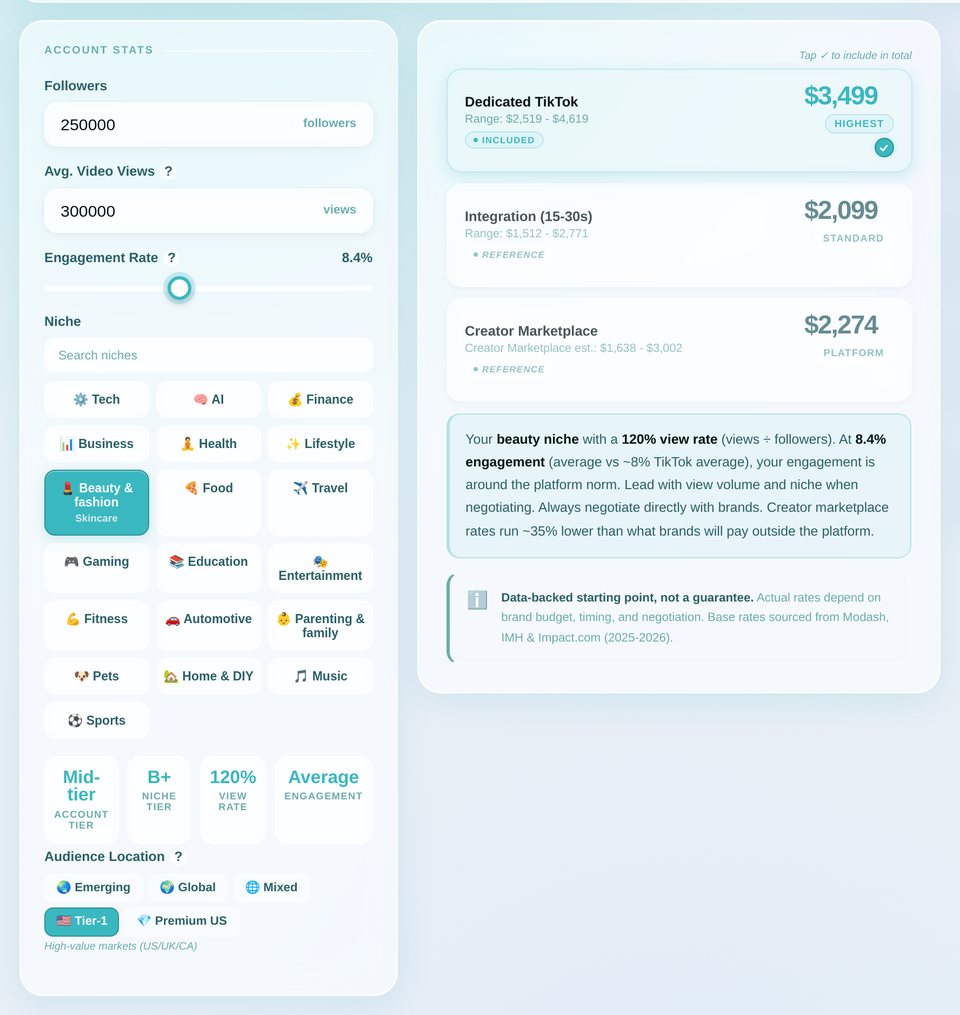
This is the same logic SponsorCraft runs automatically. It applies your actual audience geography as a multiplier on top of niche CPM and engagement, so the blended math above happens in the background instead of by hand. The TikTok sponsorship calculator also weighs your view rate against the platform average and prices dedicated video, integration, and Creator Marketplace deals separately.
Niche still sets a baseline before geography multiplies it. SponsorCraft prices against 19 creator niches and 111 sub-niches, so a skincare channel and a nail art channel, both inside the wider beauty niche, start from different baselines before country ever enters the calculation.
Price your actual audience.
SponsorCraft factors your real audience geography into every TikTok, YouTube, Instagram, and Shorts rate, then hands you a rate card ready to send.